

System Tray Menus
Add system tray (notification area) integration to your application
System Tray Menus
Wails provides unified system tray APIs that work across all platforms. Create tray icons with menus, attach windows, and handle clicks with native platform behaviour for background applications, services, and quick-access utilities.
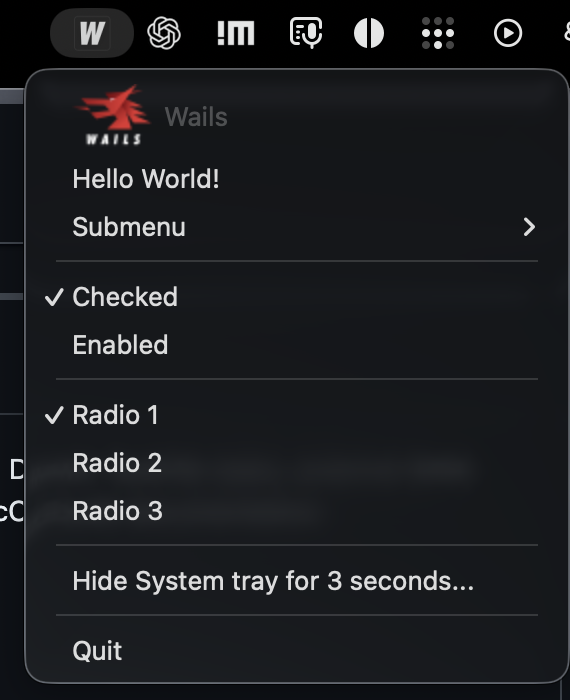
On macOS, a Wails system tray item appears in the menu bar and opens a native menu. The example includes disabled, checkbox, radio, submenu, and action items.
Quick Start
package main

import (
    _ "embed"
    "github.com/wailsapp/wails/v3/pkg/application"
)

//go:embed assets/icon.png
var icon []byte

func main() {
    app := application.New(application.Options{
        Name: "Tray App",
    })

    // Create system tray
    systray := app.SystemTray.New()
    systray.SetIcon(icon)
    systray.SetLabel("My App")

    // Add menu
    menu := app.NewMenu()
    menu.Add("Show").OnClick(func(ctx *application.Context) {
        // Show main window
    })
    menu.Add("Quit").OnClick(func(ctx *application.Context) {
        app.Quit()
    })
    systray.SetMenu(menu)

    // Create hidden window
    window := app.Window.New()
    window.Hide()

    app.Run()
}
Result: System tray icon with menu on all platforms.
Creating a System Tray
Basic System Tray
// Create system tray
systray := app.SystemTray.New()

// Set icon
systray.SetIcon(iconBytes)

// Set label (macOS) / tooltip (Windows)
systray.SetLabel("My Application")
With Icon
Icons should be embedded:
import _ "embed"

//go:embed assets/icon.png
var icon []byte

//go:embed assets/icon-dark.png
var iconDark []byte

func main() {
    app := application.New(application.Options{
        Name: "My App",
    })

    systray := app.SystemTray.New()
    systray.SetIcon(icon)
    systray.SetDarkModeIcon(iconDark)  // macOS dark mode

    app.Run()
}
Icon requirements:
| Platform | Size | Format | Notes |
|---|---|---|---|
| Windows | 16x16 or 32x32 | PNG, ICO | Notification area |
| macOS | 18x18 to 22x22 | PNG | Menu bar, template recommended |
| Linux | 22x22 to 48x48 | PNG, SVG | Varies by DE |
Template Icons (macOS)
Template icons adapt to light/dark mode automatically:
systray.SetTemplateIcon(iconBytes)Template icon guidelines:
- Use black and clear (transparent) colours only
- Black becomes white in dark mode
- Name file with
Templatesuffix:iconTemplate.png - Design guide
Adding Menus
System tray menus work like application menus:
menu := app.NewMenu()

// Add items
menu.Add("Open").OnClick(func(ctx *application.Context) {
    showMainWindow()
})

menu.AddSeparator()

menu.AddCheckbox("Start at Login", false).OnClick(func(ctx *application.Context) {
    enabled := ctx.ClickedMenuItem().Checked()
    setStartAtLogin(enabled)
})

menu.AddSeparator()

menu.Add("Quit").OnClick(func(ctx *application.Context) {
    app.Quit()
})

// Set menu
systray.SetMenu(menu)
For all menu item types, see Menu Reference.
Attaching Windows
Attach a window to the tray icon for automatic show/hide:
// Create window
window := app.Window.New()

// Attach to tray
systray.AttachWindow(window)

// Configure behaviour — these are setters that return the receiver for chaining.
systray.WindowOffset(10)                          // Pixels from tray icon
systray.WindowDebounce(200 * time.Millisecond)    // Click debounce
Behaviour:
- Window starts hidden
- Left-click tray icon → Toggle window visibility
- Right-click tray icon → Show menu (if set)
- Window positioned near tray icon
Example: Popup window
window := app.Window.NewWithOptions(application.WebviewWindowOptions{
    Title:           "Quick Access",
    Width:           300,
    Height:          400,
    Frameless:       true, // No title bar
    AlwaysOnTop:     true, // Stay on top
    HideOnFocusLost: true, // Dismiss when another window receives focus
    HideOnEscape:    true, // Dismiss when the user presses Escape
})

systray.AttachWindow(window)
systray.WindowOffset(5)
HideOnFocusLost is useful for tray popups on Windows, macOS, and
click-to-focus Linux desktops. Wails disables that behaviour on Linux
focus-follows-mouse environments (including common Hyprland, Sway, and i3
setups), where leaving the popup could otherwise hide it before it can be used.
HideOnEscape remains available in those environments.
The left- and right-click behaviours above are smart defaults. An explicit
OnClick or OnRightClick handler replaces the corresponding default. For
platform checks and edge cases, see the
manual systray suite
and the systray stress example.
Click Handlers
Handle tray icon clicks:
systray := app.SystemTray.New()

// Left click
systray.OnClick(func() {
    fmt.Println("Tray icon clicked")
})

// Right click
systray.OnRightClick(func() {
    fmt.Println("Tray icon right-clicked")
})

// Double click
systray.OnDoubleClick(func() {
    fmt.Println("Tray icon double-clicked")
})

// Mouse enter/leave
systray.OnMouseEnter(func() {
    fmt.Println("Mouse entered tray icon")
})

systray.OnMouseLeave(func() {
    fmt.Println("Mouse left tray icon")
})
Platform support:
| Event | Windows | macOS | Linux |
|---|---|---|---|
| OnClick | ✅ | ✅ | ✅ |
| OnRightClick | ✅ | ✅ | ✅ |
| OnDoubleClick | ✅ | ✅ | ⚠️ Varies |
| OnMouseEnter | ✅ | ✅ | ⚠️ Varies |
| OnMouseLeave | ✅ | ✅ | ⚠️ Varies |
Dynamic Updates
Update tray icon and menu dynamically:
Change Icon
var isActive bool

func updateTrayIcon() {
    if isActive {
        systray.SetIcon(activeIcon)
        systray.SetLabel("Active")
    } else {
        systray.SetIcon(inactiveIcon)
        systray.SetLabel("Inactive")
    }
}
Update Menu
var isPaused bool

pauseMenuItem := menu.Add("Pause")

pauseMenuItem.OnClick(func(ctx *application.Context) {
    isPaused = !isPaused

    if isPaused {
        pauseMenuItem.SetLabel("Resume")
    } else {
        pauseMenuItem.SetLabel("Pause")
    }

    menu.Update()  // Important!
})Rebuild Menu
For major changes, rebuild the entire menu:
func rebuildTrayMenu(status string) {
    menu := app.NewMenu()

    // Status-specific items
    switch status {
    case "syncing":
        menu.Add("Syncing...").SetEnabled(false)
        menu.Add("Pause Sync").OnClick(pauseSync)
    case "synced":
        menu.Add("Up to date ✓").SetEnabled(false)
        menu.Add("Sync Now").OnClick(startSync)
    case "error":
        menu.Add("Sync Error").SetEnabled(false)
        menu.Add("Retry").OnClick(retrySync)
    }

    menu.AddSeparator()
    menu.Add("Quit").OnClick(func(ctx *application.Context) {
        app.Quit()
    })

    systray.SetMenu(menu)
}
Platform-Specific Features
Menu bar integration:
// Set label (appears next to icon)
systray.SetLabel("My App")

// Use template icon (adapts to dark mode)
systray.SetTemplateIcon(iconBytes)

// Set icon position — uses AppKit NSImage placement constants.
systray.SetIconPosition(application.NSImageRight)
Icon positions (mirroring NSImagePosition):
application.NSImageLeft- Icon left of label.application.NSImageRight- Icon right of label.application.NSImageOnly- Icon only, no label.application.NSImageNone- Label only, no icon.
Best practices:
- Use template icons (black + transparent)
- Keep labels short (3-5 characters)
- 18x18 to 22x22 pixels for Retina displays
- Test in both light and dark modes
Notification area integration:
// Set tooltip (appears on hover)
systray.SetTooltip("My Application")

// Or use SetLabel (same as tooltip on Windows)
systray.SetLabel("My Application")

// Show/Hide functionality (fully functional)
systray.Show()  // Show tray icon
systray.Hide()  // Hide tray icon
Icon requirements:
- 16x16 or 32x32 pixels
- PNG or ICO format
- Transparent background
Tooltip limits:
- Maximum 127 UTF-16 characters
- Longer tooltips will be truncated
- Keep concise for best experience
Platform features:
- Tray icon survives Windows Explorer restarts
- Show() and Hide() methods fully functional
- Proper lifecycle management
Best practices:
- Use 32x32 for high-DPI displays
- Keep tooltips under 127 characters
- Test on different Windows versions
- Consider notification area overflow
- Use Show/Hide for conditional tray visibility
System tray integration:
Uses StatusNotifierItem specification (most modern DEs).
systray.SetIcon(iconBytes)
systray.SetLabel("My App")
Desktop environment support:
- GNOME: Top bar (with extension)
- KDE Plasma: System tray
- XFCE: Notification area
- Others: Varies
Best practices:
- Use 22x22 or 24x24 pixels
- SVG icons scale better
- Test on target desktop environments
- Provide fallback for unsupported DEs
Complete Example
Here’s a production-ready system tray application:
package main

import (
    _ "embed"
    "fmt"
    "time"
    "github.com/wailsapp/wails/v3/pkg/application"
)

//go:embed assets/icon.png
var icon []byte

//go:embed assets/icon-active.png
var iconActive []byte

type TrayApp struct {
    app     *application.App
    systray *application.SystemTray
    window  *application.WebviewWindow
    menu    *application.Menu
    isActive bool
}

func main() {
    app := application.New(application.Options{
        Name: "Tray Application",
        Mac: application.MacOptions{
            ApplicationShouldTerminateAfterLastWindowClosed: false,
        },
    })

    trayApp := &TrayApp{app: app}
    trayApp.setup()

    app.Run()
}

func (t *TrayApp) setup() {
    // Create system tray
    t.systray = t.app.SystemTray.New()
    t.systray.SetIcon(icon)
    t.systray.SetLabel("Inactive")

    // Create menu
    t.createMenu()

    // Create window (hidden by default)
    t.window = t.app.Window.NewWithOptions(application.WebviewWindowOptions{
        Title:  "Tray Application",
        Width:  400,
        Height: 600,
        Hidden: true,
    })

    // Attach window to tray
    t.systray.AttachWindow(t.window)
    t.systray.WindowOffset(10)

    // Handle tray clicks
    t.systray.OnRightClick(func() {
        t.systray.OpenMenu()
    })

    // Start background task
    go t.backgroundTask()
}

func (t *TrayApp) createMenu() {
    t.menu = t.app.NewMenu()

    // Status item (disabled)
    statusItem := t.menu.Add("Status: Inactive")
    statusItem.SetEnabled(false)

    t.menu.AddSeparator()

    // Toggle active
    t.menu.Add("Start").OnClick(func(ctx *application.Context) {
        t.toggleActive()
    })

    // Show window
    t.menu.Add("Show Window").OnClick(func(ctx *application.Context) {
        t.window.Show()
        t.window.Focus()
    })

    t.menu.AddSeparator()

    // Settings
    t.menu.AddCheckbox("Start at Login", false).OnClick(func(ctx *application.Context) {
        enabled := ctx.ClickedMenuItem().Checked()
        t.setStartAtLogin(enabled)
    })

    t.menu.AddSeparator()

    // Quit
    t.menu.Add("Quit").OnClick(func(ctx *application.Context) {
        t.app.Quit()
    })

    t.systray.SetMenu(t.menu)
}

func (t *TrayApp) toggleActive() {
    t.isActive = !t.isActive
    t.updateTray()
}

func (t *TrayApp) updateTray() {
    if t.isActive {
        t.systray.SetIcon(iconActive)
        t.systray.SetLabel("Active")
    } else {
        t.systray.SetIcon(icon)
        t.systray.SetLabel("Inactive")
    }

    // Rebuild menu with new status
    t.createMenu()
}

func (t *TrayApp) backgroundTask() {
    ticker := time.NewTicker(5 * time.Second)
    defer ticker.Stop()

    for range ticker.C {
        if t.isActive {
            fmt.Println("Background task running...")
            // Do work
        }
    }
}

func (t *TrayApp) setStartAtLogin(enabled bool) {
    // Implementation varies by platform
    fmt.Printf("Start at login: %v\n", enabled)
}
Visibility Control
Show/hide the tray icon dynamically:
// Hide tray icon
systray.Hide()

// Show tray icon
systray.Show()
There is no IsVisible() getter — track visibility in your own application state if you need it.
Platform Support:
| Platform | Hide() | Show() | Notes |
|---|---|---|---|
| Windows | ✅ | ✅ | Fully functional - icon appears/disappears from notification area |
| macOS | ✅ | ✅ | Menu bar item shows/hides |
| Linux | ✅ | ✅ | Varies by desktop environment |
Use cases:
- Temporarily hide tray icon based on user preference
- Headless mode with tray icon appearing only when needed
- Toggle visibility based on application state
Example - Conditional Tray Visibility:
func (t *TrayApp) setTrayVisibility(visible bool) {
    if visible {
        t.systray.Show()
    } else {
        t.systray.Hide()
    }
}

// Show tray only when updates are available
func (t *TrayApp) checkForUpdates() {
    if hasUpdates {
        t.systray.Show()
        t.systray.SetLabel("Update Available")
    } else {
        t.systray.Hide()
    }
}
Cleanup
Destroy the tray icon when done:
// In OnShutdown
app := application.New(application.Options{
    OnShutdown: func() {
        if systray != nil {
            systray.Destroy()
        }
    },
})
Important: Always destroy system tray on shutdown to release resources.
Best Practices
✅ Do
- Use template icons on macOS - Adapts to dark mode
- Keep labels short - 3-5 characters maximum
- Provide tooltips on Windows - Helps users identify your app
- Test on all platforms - Behaviour varies
- Handle clicks appropriately - Left-click for main action, right-click for menu
- Update icon for status - Visual feedback is important
- Destroy on shutdown - Release resources
❌ Don’t
- Don’t use large icons - Follow platform guidelines
- Don’t use long labels - Gets truncated
- Don’t forget dark mode - Test on macOS dark mode
- Don’t block click handlers - Keep them fast
- Don’t forget menu.Update() - After changing menu state
- Don’t assume tray support - Some Linux DEs don’t support it
Troubleshooting
Tray Icon Not Appearing
Possible causes:
- Icon format not supported
- Icon size too large/small
- System tray not supported (Linux)
Solution:
There is no SystemTraySupported() helper; instead create the tray, check the platform, and degrade gracefully:
// Probe support: on Linux without a notification-area extension, the tray
// will simply not appear. Defensive code can fall back to window-only mode
// based on runtime.GOOS or after a short timeout if no tray events arrive.
systray := app.SystemTray.New()
systray.SetIcon(iconBytes)
Icon Looks Wrong on macOS
Cause: Not using template icon
Solution:
// Use template icon
systray.SetTemplateIcon(iconBytes)

// Or design icon as template (black + transparent)
Menu Not Updating
Cause: Forgot to call menu.Update()
Solution:
menuItem.SetLabel("New Label")
menu.Update()  // Add this!
Next Steps
Complete reference for menu item types and properties.
Create application menu bars.
Create right-click context menus.
Explore a complete system tray application.
Questions? Ask in Discord or check the system tray examples.